


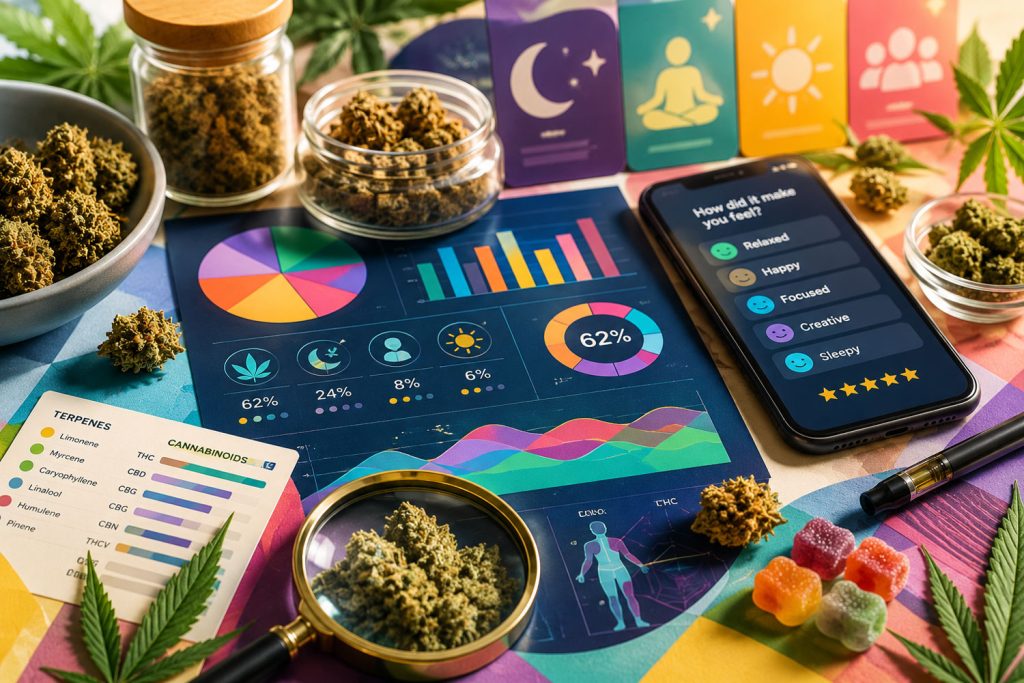
The cannabis industry has changed dramatically over the past decade. Legal markets have expanded, scientific research has accelerated, and consumers today have access to more products, information, and education than ever before.
Yet despite all this progress, some cannabis myths simply refuse to disappear. Many of these misconceptions influence purchasing decisions, shape consumer expectations, and sometimes even lead to disappointing experiences.
Let’s take a look at some of the most common cannabis myths and what current research actually tells us:
Myth #1: Higher THC Always Means Better Cannabis
This is probably the most widespread myth in the industry. Many consumers automatically assume that the product with the highest THC percentage must be the best choice. In reality, cannabis is far more complex. Research increasingly suggests that cannabinoids, terpenes, consumption methods, dosage, and individual biology all influence the overall experience. A product with 18% THC may provide a more enjoyable and balanced experience for one person than a product with 30% THC. Higher THC does not automatically mean:
- Better quality
- Better flavour
- Better effects
- Better value
In fact, some experienced consumers actively seek products with moderate THC levels because they prefer a more balanced experience.
Myth #2: Indica Makes You Sleepy and Sativa Gives You Energy
Most cannabis consumers have heard this rule:
- Indica = relaxing.
- Sativa = uplifting.
While these labels can sometimes help describe a product, modern cannabis science suggests the reality is far more complicated. Today’s cannabis genetics have been heavily crossbred over decades, making pure indica and pure sativa varieties increasingly rare. Researchers now believe that factors such as terpene profiles, cannabinoid ratios, dosage, and individual response may be more important than the traditional indica/sativa distinction. That’s why two products labelled as “indica” can produce noticeably different experiences.
Myth #3: Strong Smell Means Strong Effects
Many people believe that the stronger a product smells, the stronger its effects will be. The truth is that aroma and potency are not the same thing. Strong aromas often come from terpenes, the compounds responsible for many of the flavours and scents found in cannabis. A product can have a powerful aroma while containing moderate THC levels. Likewise, some highly potent products may have a less intense smell. Aroma can tell you a lot about character and profile, but not necessarily about strength.
Myth #4: Expensive Cannabis Is Always Better
Price can reflect quality, but not always. Factors that influence pricing include:
- Brand positioning
- Packaging
- Production scale
- Distribution costs
- Market demand
Some excellent products are reasonably priced, while some premium-priced products may not justify the difference. The best approach is to evaluate products based on consistency, freshness, cultivation methods, cannabinoid content, terpene profile, and personal experience rather than price alone.
Myth #5: More Cannabis Always Produces Better Results
Many consumers assume that if a small amount works, a larger amount will work even better. However, cannabis does not always follow this logic. For many people, there is an optimal dose range. Beyond that point, increasing consumption may lead to:
- Less enjoyable experiences
- Increased fatigue
- Reduced focus
- Greater discomfort
Finding the right amount is often more important than consuming the largest amount. This is one reason why experienced consumers frequently talk about “dialling in” their ideal dose.
Myth #6: All Cannabis Products Affect Everyone the Same Way
Perhaps the biggest myth of all is that cannabis works identically for everyone. The reality is that every consumer is different. Factors such as:
- Body chemistry
- Tolerance
- Experience level
- Consumption method
- Environment
- Expectations
can all influence the experience.
A product that one person describes as relaxing may feel completely different to someone else. This is why personal experimentation, responsible consumption, and good guidance remain so important.
Why These Myths Matter
Cannabis is evolving rapidly. As the industry matures, consumers are becoming more educated and more interested in understanding what is actually happening behind the label. The future of cannabis is not about chasing the highest THC percentage or relying on outdated stereotypes. It’s about making informed choices based on better information, personal experience, and a deeper understanding of the plant itself.
The more we challenge old myths, the better equipped consumers become to find products that genuinely suit their preferences and goals.
Final Thoughts
Cannabis has one of the richest cultures and histories of any plant on earth, but it also carries decades of misconceptions. Some myths contain a grain of truth. Others have simply been repeated so many times that they became accepted as fact. The good news is that research continues to grow, consumers continue to learn, and the industry continues to evolve.
And as that happens, one thing becomes increasingly clear: The best cannabis choice isn’t always the strongest, the most expensive, or the one with the highest THC percentage. It’s the one that works best for you.